
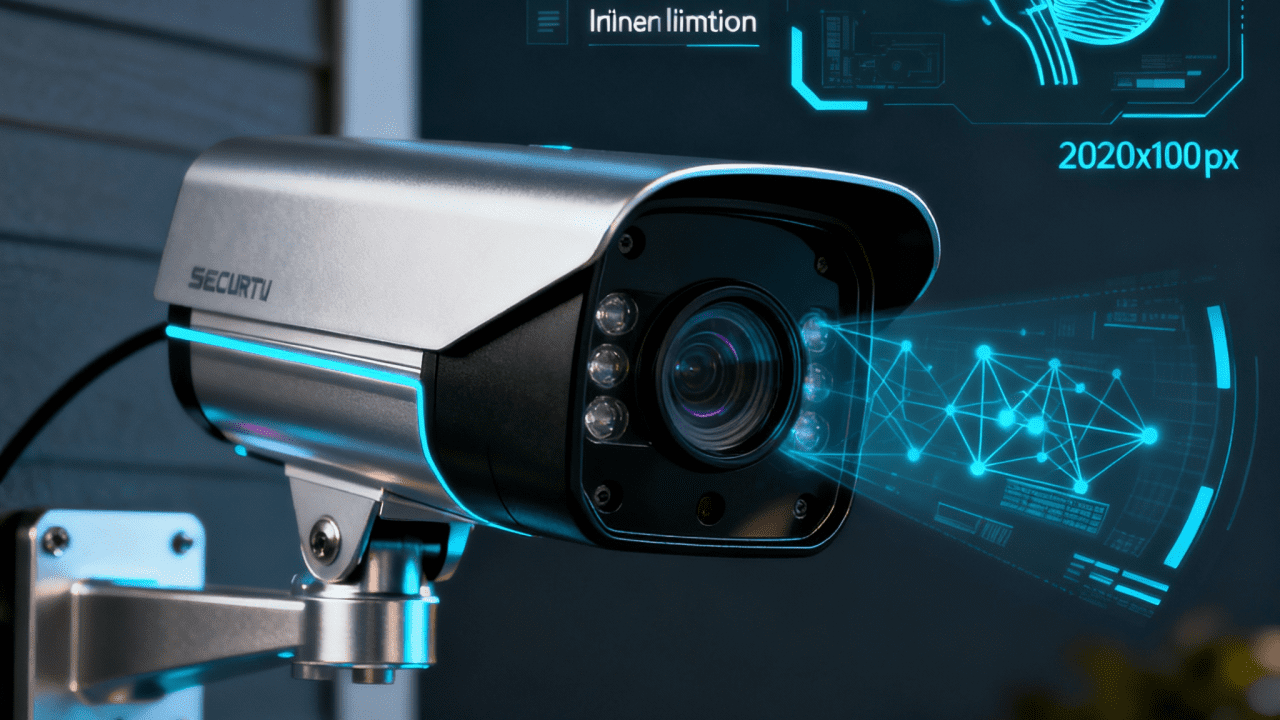

Imagine ymagine your security guard is looking at video feeds from different angles. Suddenly, the screen shows a motion alert. The guard’s heart rate jumps. They scan tour security guard is looking at video feeds from different angles. Suddenly, the screen shows a motion alert. The guard’s heart rate jumps. They scan the video to determine a threat. But a few seconds later, they realize it is a tree swaying in the wind. It happens throughout the night, creating several panicky moments and false alarms!
Has your security guard reported such an incident, or have you experienced one yourself? Then, these are the challenges of conventional surveillance systems. They eye your property every moment. But they are passive. Detecting, assessing, and responding to a threat remains the operator’s onus.
Now, what if we tell you there’s an intelligent way to deal with situations like these? In other words, you can give your security cameras a brain! Precisely, the system can differentiate between a falling leaf and a real intruder. This is where analytical software for perimeter inclusion steps in. It can think smartly and lead to fewer false alarms. Besides, you can integrate it into your existing IP camera. Feels intriguing, right? Let’s explore.
What is Perimeter Intrusion Detection?
It is about identifying when a person or object crosses into a restricted area. It is a smarter approach to security that overcomes the various challenges of conventional security management. Perimeter intrusion detection leverages analytics to identify suspicious behavior in real time. For instance, instead of alerting at every movement (as you saw in the earlier example), the system differentiates between an animal and a trespasser.
What Role Does Analytical Software Play?
Analytical software is the intelligence that makes standard IP camera systems smarter. Basic motion detection flags any movement. However, analytical software uses advanced video analytics to understand context. Some ways through which analytical software strengthens perimeter security include the following.
• Identifying line crossing or trespassing into a predefined zone.
• Tracking dubious behavior like loitering near a restricted zone or gate.
• Differentiating between humans, animals, and objects.
• Reducing false alarms by ignoring irrelevant movements like shadows.
Unlike old-school cameras that are reactive, advanced video analytics refers to being proactive. The latter doesn’t just record events and provide a historical log. Instead, while recording an event, the system also actively detects and analyzes an instance in real time.
Integration with Existing Cameras
Analytical software is gaining momentum across various premises and applications. Of course, intelligence is one reason. But another significant reason is that it can work with your existing IP cameras! Thus, instead of replacing hardware, institutions can overlay intelligence by integrating software. This ability translates into several benefits, like;
• Affordability: Integration with existing IP cameras eliminates the need for expensive new camera installations.
• Quicker Implementation: Installation becomes much simpler and faster as you can integrate with the system using the existing IP cameras.
• Scalability: You can deploy the software application across different sites. Besides, you can scale when needed and as your security needs grow and evolve.
• Remote Monitoring: Your security teams can receive alerts across facilities without anchoring them to a single control room.
How Does the Brain Behind the Lens Work?
Analytical software applies AI and ML algorithms to the camera’s video streams. Essentially, it turns a passive camera feed into a sophisticated, smart sensor.
Here’s how these brains behind the lens work.
• Object Classification: Analytical software is trained on data to know the difference between a car, a dog, a human being, etc. This capability helps reduce false alarms.
• Behavioral Analysis: The software also analyzes behavior. You can further enhance the system’s capabilities by setting up geofences or virtual tripwires. So, when a person crosses the virtual line, the system would know it must flag it.
• Real-Time Alerts: When someone violates a predefined rule, the system sends a verified alert to the security staff. It would be a confirmed event with a video clip attached, enabling quick assessment, response, and action.
Key Features of Perimeter Intrusion Analytics
Modern analytical software offers numerous features that provide accurate and reliable intrusion detection. Some key capabilities or features include;
• Virtual Fencing: Digital boundaries within the camera’s field of view, triggering alerts when someone or something crosses the line.
• Real-Time Alerts: As stated earlier, the system sends verified alerts about threats to which the security personnel can respond in real time.
• System Integration: The system can integrate with Video Management Systems (VMS) alarms or access control for a blissful security workflow.
• AI-Based Object Recognition: The software leverages AI and ML to differentiate between an animal, a human being, and an object.
• Flexible Deployment: You can choose between cloud and on-premise deployment based on your security policies and existing IT infrastructure.
How Does Integrating Analytics with Existing IP Cameras Benefit Organizations?
Practically, it does so in various ways. These include the following.
• Better Security Operations: Automated alerts that reduce the need for continuous manual monitoring, freeing security personnel to focus on better tasks.
• Threat Prevention: Real-time threat detection enables institutions to prevent theft, trespassing, or instances of vandalism before the damage takes place.
• Quicker Responses: Security teams can act on real-time, verified alerts instead of reviewing hours of video footage while investigating an incident.
• Regulatory Compliance: Various industries need a document proving perimeter security. Analytics provide audit-ready reports.
• Improved Situational Awareness: The system provides detailed, contextual information with each alert, including factors like event clip, entry time, etc.
Key Considerations While Implementing Analytical Software
You can optimize the benefits of this move only when you implement the software appropriately. Here are some key considerations.
• Ensure adequate lighting in the camera’s view.
• Position the cameras appropriately.
• Use high-resolution cameras to enhance visibility.
• Ensure network readiness for higher-quality and quicker analytics.
• The system must be encrypted and have robust security protocols.
Prepared to Transform Your Security Operations with Analytical Software?
Choose DAccess. We are trusted custom analytical software partners. Our software systems have robust AI and ML capabilities. They enhance your security operations and make your premises more secure. So, why wait and live with the challenges of traditional surveillance? Embrace advanced technology to make your premises safer with DAccess. Please email us at info@daccess.co.in to explore more.