

In India, elections are more than just a democratic affair. They are massive, complex events that involve nearly a billion people. Yes. That’s an unignorable number, isn’t it?
However, it isn’t just about the number. Elections involve millions of polling stations and even more security personnel. Hence, elections in India require extensive logistical planning. People, infrastructure, and importance. Elections have it all!
Now, every vote counts and contributes to the nation’s progress. But the security of voters, election officials, and the infrastructure matters just as much as the vote itself.
This is where crowd management enters.
India, including each of its states, districts, and municipal corporations, expects a larger voter turnout every year. It means more crowded polling stations. Conventional security management techniques fall short while handling such massive crowds.
So, how do you deal with the situation and ensure election security? Automated access control can make a significant difference. Let’s focus on it in this blog.
Why Manual Crowd Management is Longer Competent: Common Challenges
In India, election security has been relying on an analog system for years. It comprised ropes, bamboo barricades, and police personnel with nothing but a baton (lathi) to control crowds. While complicating security management, it raised questions about the vote and personnel safety. The system gave birth to numerous challenges, including;
· Excessive Human Dependency: Checking voter slips and IDs manually slows the process. As a result, queues grow quickly, building up frustration.
· Friction and Frustration: The voting process has a fixed time-frame. Therefore, slow processes and inefficient security culminate in frustration. People begin arguing with the security staff. Some even attempt to trespass.
· Security Gaps: Manual crowd management isn’t just slow. It is also a serious security threat. While managing crowds, security personnel may miss spotting and catching a trespasser or suspicious behavior.
· Overcrowding: Managing crowds manually hinders the ability to count people in real-time. As a result, too many people may enter the polling compound at once. This is a serious violation of the guidelines of the Election Commission.
· Human Limitations: Archaic crowd control relies on human security. But humans have limitations. Some include errors, fatigue, inconsistent enforcement, slow verification, challenges while handling surges, and limited real-time visibility.
You cannot treat security casually when it comes to elections anywhere in India. Hence, there’s a need to shift from reactive to proactive crowd management.
Let’s explore if Automated Access Control works it out.
6 Ways Automated Access Control Proves to be the Game-Changer
Automated access control refers to a more capable system. That’s because it combines data, technology, and intelligent, real-time monitoring. All these factors are cornerstones of modern security management. These ensure safe, smooth, and more accurate security management. The result is safer and more transparent polling operations! Here’s more.
1. Regulating Crowd Metering
In India, each polling station has thousands of voters. Everyone is in a hurry. Therefore, a chaotic rush is obvious when the gates open. However, that can create a potential security situation and disrupt the election process.
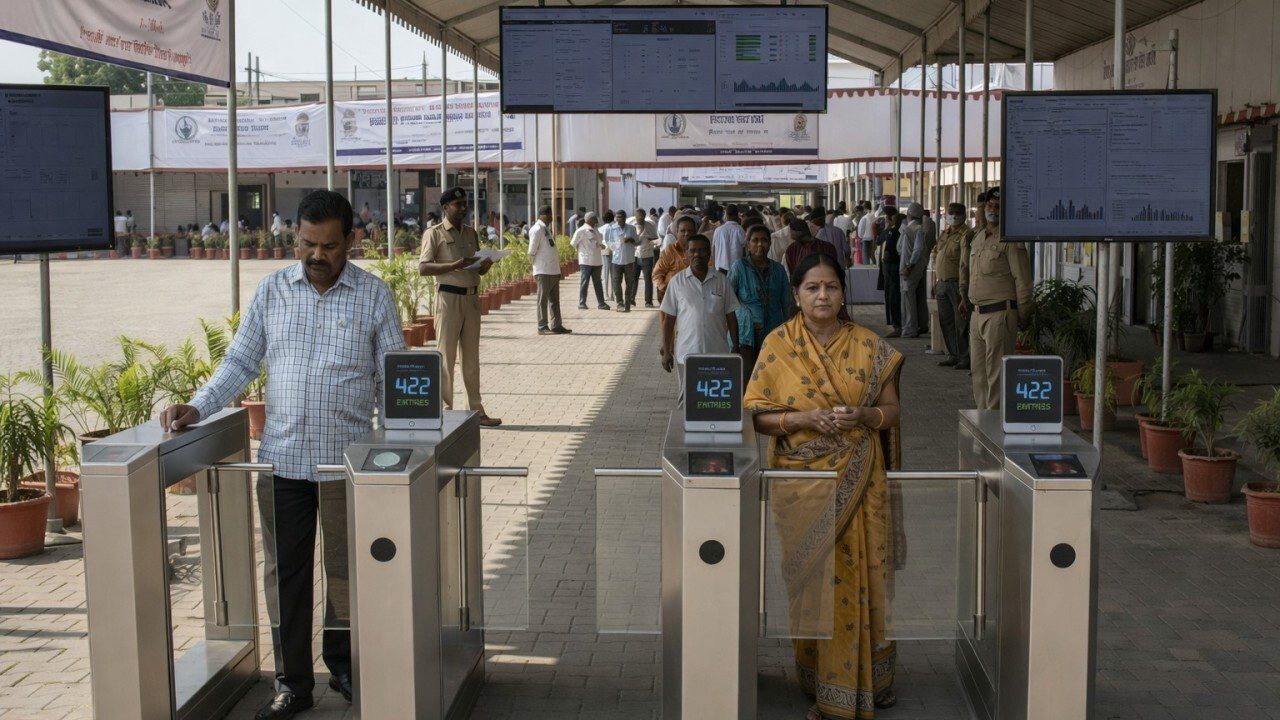
Automated barriers allow only one person to pass at a time. While avoiding chaos, it maintains orderly queues and prevents stampedes. Furthermore, the system ensures that the number of people inside the polling booth doesn’t exceed its maximum capacity.
2. Facial Recognition Verification
Voter ID verification is currently manual. But with an increase in voter turnout, advanced technology is likely (instead, it must) enter the scene. Automated access control can be integrated with a facial recognition system and linked to electoral databases. So, the entry gate will have a camera that scans the voter’s face and verifies their identity against the database. The process will be completed in seconds. The gate will open thereafter.
Integrating facial recognition will expedite the verification process. It will reduce reliance on manual verification, minimize human errors, and improve voting experiences.
3. Real-Time Occupancy Monitoring
Automated access control produces live data. This data can help magistrates and police heads count the number of people inside a particular booth. Additionally, they can monitor entry rate and average wait times. Entries will automatically slow down if the booth nears its maximum capacity. It will help prevent overcrowding and chaos.
4. Eliminating Human Friction
Friction, in the form of arguments, is common where humans are present. This can lead to unforeseen issues and potential security situations.
However, machines don’t get tired. They don’t get angry either. Automated access control automates the initial entry point by auto-scanning IDs. It minimizes verbal exchanges between voters and security personnel. Remarkably, automation streamlines the process and makes it more peaceful.
5. Intelligent Lane Prioritization
Voters belong to different age groups. Some are young, first-timers. Many others are older adults and senior citizens. Manual crowd management usually generalizes queues. So, whether an 18-year-old or an 81-year-old, both stand in the same queue. But automated access control customizes lanes based on the crowd. For instance, it can create a dedicated lane for senior citizens. Such customization can accelerate access and make voters feel valued.
6. Post-Election Analytic
Manual entries don’t generate data. But automated systems do. Such data can serve as a knowledge center for election administrators and authorities. They can use it to analyze peak voting hours, average per-voter processing time, and bottlenecks. An analytical approach like this can help authorities optimize resource allocation and make crowd management even more seamless the next time.
Final Words
Elections are integral to the democratic form of governance. However, the success of elections depends on numerous factors. Voter response is one of the most crucial ones.
Often, many voters avoid voting due to long waiting times and slow manual procedures. That’s detrimental to the election process. Essentially, even to democracy.
Automated access control alone cannot change the situation. But they can contribute positively by enhancing the voting experience – something no one ever discusses!
Now, if you are a security administrator looking to streamline election procedures within your scope, DAccess has got you covered.
Our entrance automation system (Gate System) enables automated access control to provide real-time monitoring, management, and control.
Trusted by hundreds worldwide, our entrance automation systems are designed with modern crowd management needs and expectations in mind.
So, would you like to explore more about our automated access control systems? Please email us at info@daccess.co.in.