
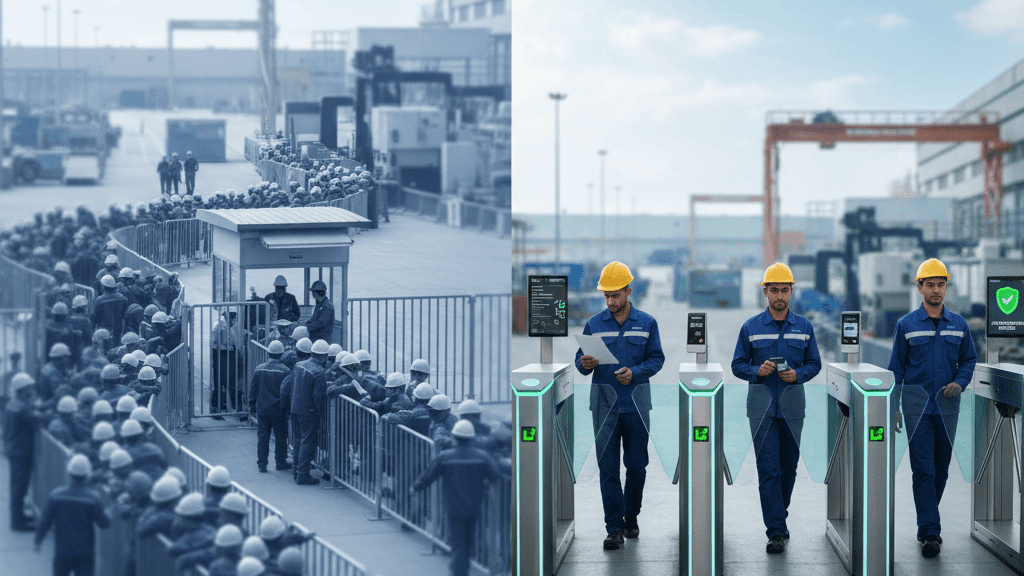

Hammers hitting metals, machines hissing, and the rhythmic thud of production – all these are sounds of progress, growth for a manufacturing company.
However, for a manufacturing unit we served, a noise echoed louder than these sounds. It was the chaotic clamor of a shift change.
Shift change would be an absolute mess for the company. Employees and contract labor would throng at the entrance point, waiting to enter. Security guards would be on their toes to complete the entrance formalities. Every employee would get restless after a while to avoid a late mark. Over a period, these concerns had become normal.
Wondering why? Manual entrance management.
For an otherwise progressing company, entrance management had become a critical pain point. Entrance delays were affecting production hours. Although these delays had become somewhat normal, everyday, the company would lose hundreds of vital man-minutes of production. So, along with the growing security concerns, the management was also worried about the productivity losses.
That’s where our smart turnstiles entered the scene and helped the company improve its entry security by 60%. Of course, we did not have a magic wand but an organized solution that drove results over a period. Here’s a comprehensive article about it.
Growing Security Challenges Across Manufacturing Units
Manufacturing units have unique entry security challenges. Unlike corporate offices that have a couple of rush hour slots in the day, manufacturing units have many. Some challenges we observed in many manufacturing units, including the one we served, were;
· High Employee Footfall: Manufacturing units usually manage production schedules across multiple shifts. Therefore, you would see at least a hundred people at any given point in time at the entrance waiting to enter the premises.
· Daily People’s Movement: Besides employees, these companies have many others, such as vendors, contractors, visitors, transport trucks, etc., entering the premises at different hours. These entries would add to the already chaotic situation.
· Sensitive Machinery: Entrance delays were one aspect. But not the only one. Manufacturing units house sensitive, costly machinery. Therefore, safeguarding them is another critical challenge.
· Safety and Compliance Requirements: Manufacturing companies have several safety-related compliances. The ones we observed were at risk of non-compliance due to entry security challenges.
· Tailgating: To avoid delays, multiple people would attempt to enter on a single authorization. Many of them would succeed in tailgating.
· Unauthorized Access: Entry point chaos would often allow unauthorized people to enter, putting sensitive machinery, people, processes, and output at risk.
· Manual Documentation: Visit entries would be recorded in manual registers. As a result, tracking entries, exact headcount, and auditing would be challenging.
· Overdependence on Human Personnel: Entry security relied heavily on human personnel, resulting in flaws, gaps, and frequent misses.
Why Conventional Access Control Was Failing in the Manufacturing Unit
The facility relied on a combination of conventional (human security) and modern access control (RFID access cards). Now, this may seem adequate to many. It is because security should, anyway, combine human and technology. However, the approach was flawed with limitations. The system was failing on various fronts due to;
· Human Dependency: A couple of guards or at most three guards would manage hundreds of entrants at any point. While tiring, it would also result in inconsistencies as the guards couldn’t monitor every entry equally. Therefore, shift changes would often be a chaotic scene.
· Card Misuse: Employees would occasionally share access cards with each other. While unintentional in some cases, in many others, it would be intentional.
· No Real-time Data: Management could never have full visibility into the number of entrants, their real identities, time of entry, purpose, and visiting details.
· Scalability Issues: Over a period, the company received many more projects. This led to a significant growth in the workforce. But the security arrangements couldn’t keep up with this growth. As a result, the situation turned even more challenging.
The above challenges made something very clear. Temporary solutions wouldn’t work for the company. It required a long-term solution – precisely a smart, tech-driven approach. After assessing the entire situation, we devised a custom solution.
Enter Smart Turnstiles – What are They?
Smart turnstiles are automated pedestrian access control systems that merge physical barriers with digital technology such as RFID, biometric, and NFC. Together, elements help manage entry securely, log visitor data, and prevent unauthorized access.
Turnstiles off real-time monitoring, ensure quick authentication, and integrate seamlessly with workforce software to enhance security and efficiency across areas that experience high footfall. Besides, they allow only one person at a time. Hence, they are a reliable entrance management solution across larger facilities.
Key Features of Turnstiles that Transformed Large-Scale Entrance Management
Smart turnstiles emerged as a unanimous solution to tackle entrance security challenges. The features that influenced our decision included;
· RFID and Biometric Authentication: This feature helped eliminate the need to maintain manual registers and rely on information provided by the entrant. Instead, RFID and biometric authentication validated visitor identity and ensured accurate verification. So, no more fake entries. Security personnel would know who exactly is inside the company’s premises.
· Anti-Tailgating Mechanism: Smart turnstiles allow only one person at a time. This feature helped the company prevent multiple entries. So, unlike earlier, when multiple people would enter a single register entry, turnstiles would ensure only one person would enter (and the same person) would enter for a respective entry.
· Real-Time Monitoring and Reporting: The turnstile would provide a dashboard and database to monitor people’s presence in real-time and generate detailed reports to analyze it and make informed decisions concerning security.
· Integration Capabilities: Our smart turnstiles can integrate effortlessly with the existing HR and attendance systems. They did so with those of the company as well, ensuring seamless interaction, a comprehensive view, and in-depth insights.
Shop Floor Implementation
For a facility of this size, we planned a phased implementation that involved strategic placement, system integration, and employee enablement.
Strategic Placement
Smart turnstiles were installed at:
· Main employee entry and exit gates
· Shop-floor access points
· High-security or restricted zones
System Integration
The turnstiles were integrated with:
· Employee databases
· Shift and attendance management systems
· Visitor management software
The above helped update access rights automatically based on roles, shifts, and authorization levels.
Employee Enablement
Our support went beyond actual implementation. While implementing and even after, we maintained clear communication and conducted short training sessions to enable quick and seamless user adoption. Of course, we experienced initial resistance. However, gradually, people became habituated to the system. Over time, they started experiencing quicker, hassle-free entries that further helped reduce resistance levels.
The Outcomes: Entry Security Improved by 60%!
We achieved measurable and significant results within just months of deployment.
· Unauthorized entries reduced by 60%
· Tailgating incidents nearly eliminated
· Security had better control over contractor and visitor access than ever
· The company now had transparent audit trails for every entry and exit
Remarkably, the smart turnstiles ensured the authentication of each person entering the facility. It ensured one entry at a time, increased movement efficiency, and minimized security concerns significantly.
Going Beyond Security: Operational Benefits
Security, of course, was the primary goal of installing smart turnstiles. However, installing the system translated into a few other benefits as well, including;
· Quicker, More Organized Movement: Smoother shift changes, reduced entry congestions, and faster employee movements.
· Accurate Attendance Tracking: Automated logs replaced manual attendance, decreased administrative effort, and reduced payroll discrepancies.
· Improved Compliance and Audit Readiness: Ready availability of detailed access reports, quicker audits, and better compliance.
· Reduced Reliance on Manual Supervision: Efficient management with fewer security staff and more focus on higher-value tasks.
Are You Also Struggling with Entrance Security Challenges?
Then, partner with DAccess and install our smart turnstiles. Our smart turnstiles are a single system that serves multiple purposes, while enhancing security efficiency. They automate entry management, validation, and verification, and enable smart monitoring through dashboards and informed decision-making through comprehensive reports.
So, don’t struggle with manual entry security management. Experience automated, tech-powered entrance management with our smart turnstiles. Want to book a comprehensive demo? Please email us at info@daccess.co.in.