
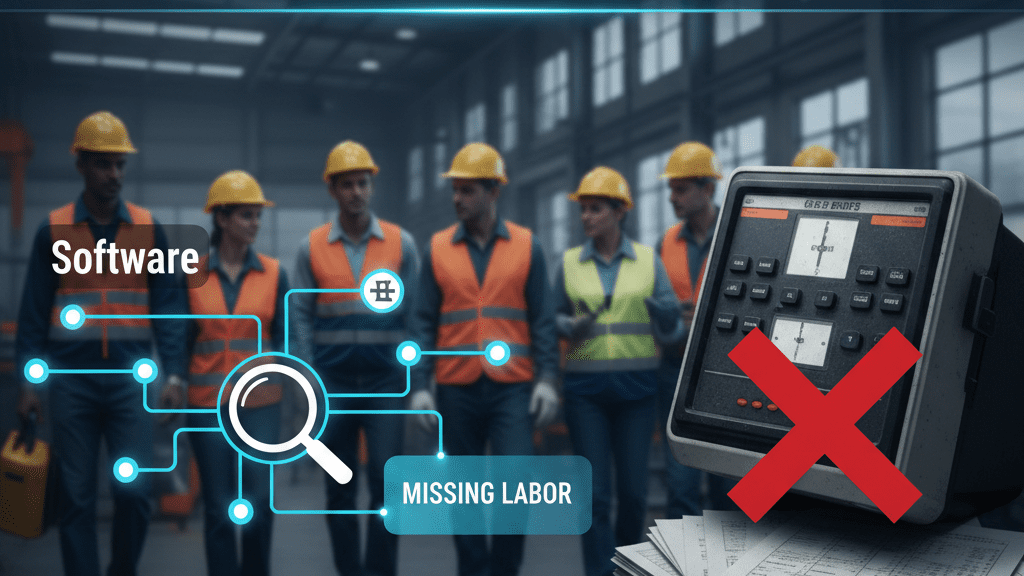

Contract labour is a cost-effective model. It is commercially more viable to manage contract labour than in-house. Besides, the model is more scalable as well.
However, the model can also bring some inconveniences.
One of the most crucial ones is tracking the labour. Many organisations still follow manual approaches, such as paper registers and archaic spreadsheets, to track labour.
So, the modern, competitive environment requires a smarter, more tech-driven approach. Contract labour management software helps address them. Let’s see in what ways.
Challenges of Manual Contract Labour Tracking
It is convenient to tread the manual path. But manual tracking often produces challenges, many of which distress the HR, finance and operations team. Here are some of the most common challenges companies face with the archaic approach.
· Inaccurate, Fragmented Data: Manual record-keeping is prone to mistakes. Besides, when each department maintains a separate labour record, the data the HR receives often remains fragmented, hindering decision-making.
· Lack of Real-Time Visibility: Traditional record-keeping doesn’t give you full visibility. You only know something after it happens. This complicates routine manpower planning, schedule adjustments or tracking site productivity.
· The Arduous Compliance Function: Registering every contractor, remembering license dates, complying with statutory requirements, and ensuring payroll compliance can often become overwhelming due to manual tracking.
· Payroll Leakages: Inaccurate or incomplete data reduces visibility into the actuals. In a situation like this, HR executives fail to calculate contract labour payments accurately. Thus, you may end up overpaying the contractor.
· Operational Delays: Locating records, validating worker credentials, checking attendance, and reconciling contractor bills can consume a lot of the manager’s and HR’s valuable productive time. It can delay operations significantly.
Integrating a contract labour management software system simplifies life, addressing all the above challenges. It makes the otherwise daunting task of contract labour tracking a seamless experience, ensuring accuracy, real-time tracking and informed decision-making. Let’s now explore how the system makes it possible.
5 Ways Contract Labour Management Software Flips the Script for You
From providing a centralised dashboard to track labour activity to insight-driven decision-making, here are five reasons you must upgrade to a contract labour management software system.
1. Centralised Labour Tracking Dashboard
Contract labour management system provides a centralised view of labour attendance, contractor profiles, compliance documents, payroll, work orders, etc., through a single dashboard.
By doing so, it eliminates the effort you would otherwise make while sifting through enormous amounts of data manually and multiple files. Your managers and supervisors can instantly track the attendance in real-time.
Furthermore, you can customise the dashboard based on your specific requirements to see what you need. Additionally, you can scale the dashboard view for multiple locations to track the status of each from a single place.
For instance, your plant manager looks at the dashboard to discover that 25 contract labour workers haven’t scanned in, and it is already 9:30 AM. This can help them adjust the schedule or approach the contractor to send in replacements for the day.
2. Automated Attendance Capturing
Capturing the attendance of hundreds of workers manually is laborious and outdated. Besides, it may be vulnerable to errors, resulting in inaccuracies in capturing attendance. You also cannot rule out the possibilities of data manipulation!
Contract labour management software addresses these challenges effectively. It automates and expedites the task by integrating with biometric systems, barcodes, and RFID scanners to record check-ins and check-outs. Therefore, the system captures attendance accurately, while also creating a digital trail you can retrieve anytime.
For example, a bustling construction site uses facial recognition to record attendance. Thus, the system auto-calculates daily hours, flags unauthorised entries, and marks late comers and early goers. It provides your HR department with a comprehensive view of the workers’ attendance, enabling them to process payments accurately.
3. Centralised Worker Verification
Manual verification methods may be flawed, inconsistent and inaccurate. Therefore, they may result in credibility challenges across multiple locations. However, a contract labour management system creates a uniform verification process and serves as a single source of truth for all contract workers across different locations.
It also stores digital copies of ID proofs, training certificates, medical documents and police verification records. HR executives and department managers can then retrieve records whenever required, in case of an incident or non-compliance. Furthermore, it can help you blacklist such workers or those terminated across all locations.
For instance, before starting a critical machine maintenance job, the plant safety officer must confirm that all the contract workers have the Working at Heights certification. They can verify the certification and its validity through the system, instead of checking each record physically.
4. Accurate Payroll Processing
When you maintain each record, including attendance and leaves, manually, there is a chance you may be relying on inaccurate or incomplete data. This is another area where contract labour management software proves its utility.
The system uses verified, real-time attendance data to auto-calculate wages, overtime, and deductions, ensuring accuracy across each. Therefore, your HR executives will always have accurate data, ensuring correct payroll calculation. It will help eliminate over- and underpayments, making the payroll system more reliable.
For example, a manufacturing company realises that inaccurate calculations due to manual record-keeping have resulted in overpayments to nearly 72 contract workers. But installing contract labour management software helped them determine working hours and calculate leaves, etc., accurately, ensuring precise payments.
5. Insight-Driven Decision Making
Advanced contract labour management software goes beyond just tracking. It also provides comprehensive insights into labour statistics, helping decision-makers make informed decisions. The result is better resource allocation, cost optimisation, increased workforce productivity, and a stricter watch on contractor performance.
For instance, a manager takes a deeper look into the labour budget of their project and discovers that there has been unplanned downtime over the past three months. It has resulted in over-budgeting. Real-time analytics helps them adjust shifts and allocate resources optimally.
Journey from Chaos to Clarity with DAccess’s Contract Labour Management Software
Our contract labour management software brings all your HR activities under one roof. It covers features, including employee lifecycle, time and attendance, claim and reimbursement, leave management, contractor data management and more, helping you manage all your contract labour data accurately.
Thus, it is a comprehensively designed, customisable labour management platform that helps you not just track but manage contract labour efficiently.
Want to learn more or book a demo? Email us at info@daccess.co.in.